POST 0007 · MEDICARE PAYMENT
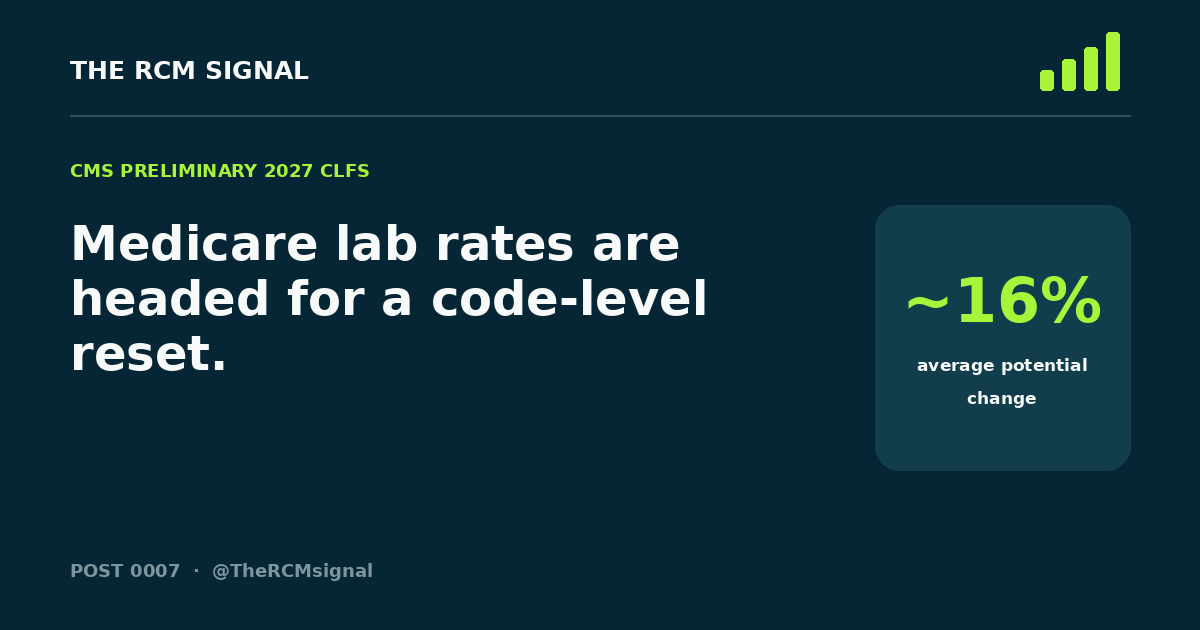
CMS’s new Clinical Laboratory Fee Schedule data point to an average potential change of about 16% below 2026 rates. The operational answer is not a flat haircut—it is a code-level revenue model.
The Centers for Medicare & Medicaid Services released preliminary calendar year 2027 payment information for the Medicare Clinical Laboratory Fee Schedule (CLFS) on September 21. The headline is striking: across codes with private-payor data, CMS reports an average potential change of about 16% below CY 2026 rates.
That number is useful for understanding the direction of travel. It is not a reliable budget assumption for an individual hospital, health system, independent laboratory, or physician-office laboratory. Local exposure depends on billed volume, code mix, current rates, payer relationships, and the statutory phase-in.
What CMS released
The preliminary rates reflect the second full private-payor data collection and reporting cycle under the Protecting Access to Medicare Act. Laboratories reported the rates private payors paid for specific tests and the volume paid at each rate. CMS then used weighted medians to inform preliminary Medicare rates.
- 6,411 laboratory NPIs submitted data.
- 6,304 applicable laboratories remained after CMS exclusions.
- 1,947 HCPCS codes were applicable.
- 1,528 codes received a weighted median from private-payor data.
CMS says it excluded exact duplicate records and records with a reported rate greater than 100 times the CY 2026 CLFS rate. The agency published preliminary results with and without the exclusions and asked for comment on whether the methodology is appropriate.
The national average hides a wide distribution
Among the codes with weighted medians and a comparable 2026 rate:
- 1,171 have a lower preliminary weighted median.
- 186 have a higher preliminary weighted median.
- 169 are unchanged.
- Two additional codes with weighted medians do not have a comparable CY 2026 CLFS rate.
The category-level spread is just as important. CMS reports potential weighted changes of -23% for genomic sequencing, -22% for molecular pathology, -19.3% for microbiology, -19.3% for immunology, -16% for chemistry, and -2.4% for proprietary laboratory analysis.
Those are category averages—not substitutes for line-by-line analysis. A laboratory concentrated in molecular and genomic testing may face a different risk profile from one concentrated in proprietary assays or a narrow group of routine chemistry tests.
The 15% cap phases in reductions
The CMS CLFS operational page states that, from 2027 through 2029, payment for a test may not be reduced by more than 15% in a year compared with the preceding year’s payment amount.
The cap matters because the potential weighted median for some tests may be more than 15% below the current rate. But the cap should be modeled as a multi-year phase-in—not treated as evidence that the underlying rate pressure has disappeared.
Why the 2026 data mix matters
Participation changed materially from the first PAMA reporting cycle. CMS reports that hospital laboratories grew from 21 reporting NPIs in 2017 to 875 in 2026, increasing from 1.1% to approximately 13.6% of reporting laboratories. Physician-office laboratories also increased from 1,106 to 3,262.
The broader participation improves representation, but it does not remove the need to test the published results against an organization’s actual volume and service mix.
A six-step revenue-cycle response
- Rank high-volume and high-dollar codes. Identify the relatively small group of HCPCS codes that drives most Medicare laboratory revenue.
- Compare current and preliminary rates. Calculate unit and total-dollar variance by code using actual volume.
- Apply the annual phase-in. Model 2027, 2028, and 2029 separately where the preliminary weighted median is more than 15% below the current rate.
- Segment the analysis. Separate hospital outpatient, outreach, independent-lab, physician-office, service-line, and payer effects.
- Validate anomalies. Review unexpected medians, outliers, and code mappings. CMS provides a 30-day public review and comment window after publication.
- Operationalize the forecast. Update budgets, contract assumptions, outreach strategy, test economics, patient estimates, and leadership reporting when warranted.
The operating calendar
- September 21, 2026: CMS published preliminary rates and supporting information.
- 30 days after publication: Public review and comment window.
- November 2026: CMS expects to publish final CY 2027 CLFS rates.
- January 1, 2027: Final CY 2027 rates take effect.
The distinction between preliminary and final is important. The right response now is to model, validate, and prepare—not to record the preliminary file as a final contracted rate.
Primary sources
- CMS: Preliminary Calendar Year (CY) 2027 Medicare Clinical Laboratory Fee Schedule Payment Rates — published September 21, 2026.
- CMS: New Preliminary Medicare Payment Rates for Laboratory Services — published September 21, 2026.
- CMS: Clinical Laboratory Fee Schedule — operational page and supporting files.
This article is an operational summary for revenue-cycle professionals. It is not legal, coding, reimbursement, or financial advice. Verify final rates and organization-specific impacts before acting.