RCM FIELD NOTES / POST 0006
Aetna Bundles Oncology Prior Authorization: What Revenue-Cycle Teams Should Rebuild Now
Aetna is moving eligible oncology care from an average of four authorization requests to one bundle. The opportunity is real—but the control problem moves downstream.
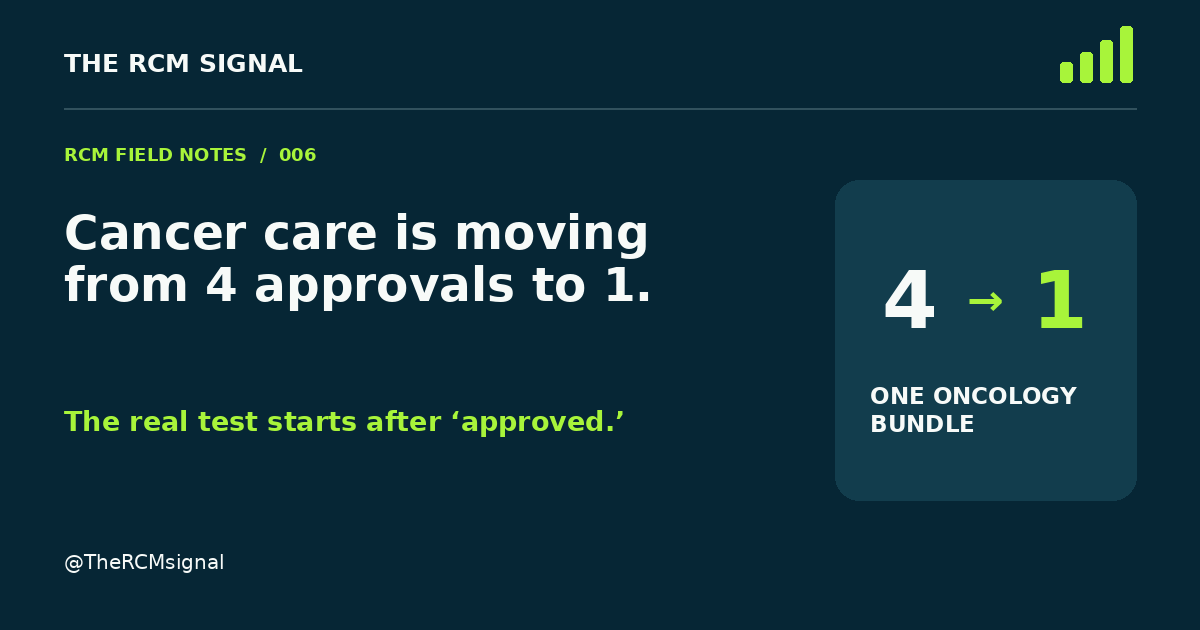
Cancer care is moving from four prior authorization requests to one. On September 17, 2026, Aetna announced that an expanded oncology bundle was already live for eligible Medicaid members in eight states. The rollout took effect September 1 and applies to providers using the Eviti portal.
The bundle can combine medical oncology—including chemotherapy and immunotherapy where appropriate—radiation oncology, and related high-tech imaging such as MRI and CT into one request. The participating Medicaid states are Oklahoma, Illinois, Maryland, New Jersey, Virginia, Florida, Kentucky, and West Virginia. Aetna’s announcement says the company plans to extend the approach to Medicare and Commercial business in the first half of 2027.
The headline: four requests become one
Aetna says providers averaged four separate prior authorizations for a member who needed cancer treatment before bundling. The company also says nearly 25% of eligible members received a bundled authorization during the initial rollout.
Those are encouraging early figures, but they are company-reported—not an independent outcome audit. Reuters independently reported the launch, while the utilization figures come from Aetna.
The signal: the control problem moves downstream
Bundling can remove repetitive submission work. It does not automatically make the approved scope visible to every team that touches the encounter or claim. One approval does not guarantee one clean claim.
The following is The RCM Signal’s operating interpretation, not an Aetna requirement. Revenue-cycle leaders should treat the bundle as an episode-level data object that must survive handoffs among scheduling, clinical teams, authorization staff, coding, billing, and denial management.
Build one episode record
At minimum, the episode record should make these fields easy to retrieve:
- authorization ID and payer reference;
- included services, procedure codes, units, and frequency;
- approved start and end dates;
- site of care and participating vendors;
- conditions that require modification or a new request;
- expiration and renewal rules; and
- the source document or portal confirmation that proves the approved scope.
The record should be shared across the workflow—not copied into disconnected notes that are difficult to reconcile at billing time.
Close the loop at claim time
- Verify scope before service. Confirm that the planned treatment, imaging, site, timing, and units match the approved episode.
- Route exceptions early. Changes in regimen, site, timing, or service mix should reach the authorization team before claim generation.
- Gate claim release. Require a complete, current episode record before the claim leaves the organization.
- Monitor denials. Separate authorization-related denials tied to bundled episodes from the rest of the denial inventory.
- Measure the operating result. Track authorization touches, rework, denial rate, and days to treatment.
Authorization does not replace eligibility, benefit, network, coding, coverage, or medical-necessity checks. The goal is not to treat the bundle as blanket payment approval. The goal is to convert fewer requests into fewer avoidable handoff failures.
Why this matters beyond Medicaid
Aetna’s planned Medicare and Commercial expansion makes the current Medicaid rollout an operating preview. Teams that define the episode record and control loop now will be better positioned if bundled authorization scales across additional lines of business.
The practical question: Can your team prove that the authorization still covers the claim that is about to leave the door?
Primary sources
- CVS Health / Aetna — “Aetna Expands Bundled Oncology Prior Authorizations”, published September 17, 2026; rollout effective September 1, 2026.
- Aetna Insights — oncology bundled prior authorization overview, accessed September 21, 2026.
- Reuters — independent reporting on the launch, published September 17, 2026.
Editorial review date: September 21, 2026. Aetna-reported figures are labeled as such. Workflow recommendations are The RCM Signal’s analysis.