
POST 0008 · VALUE-BASED PAYMENT
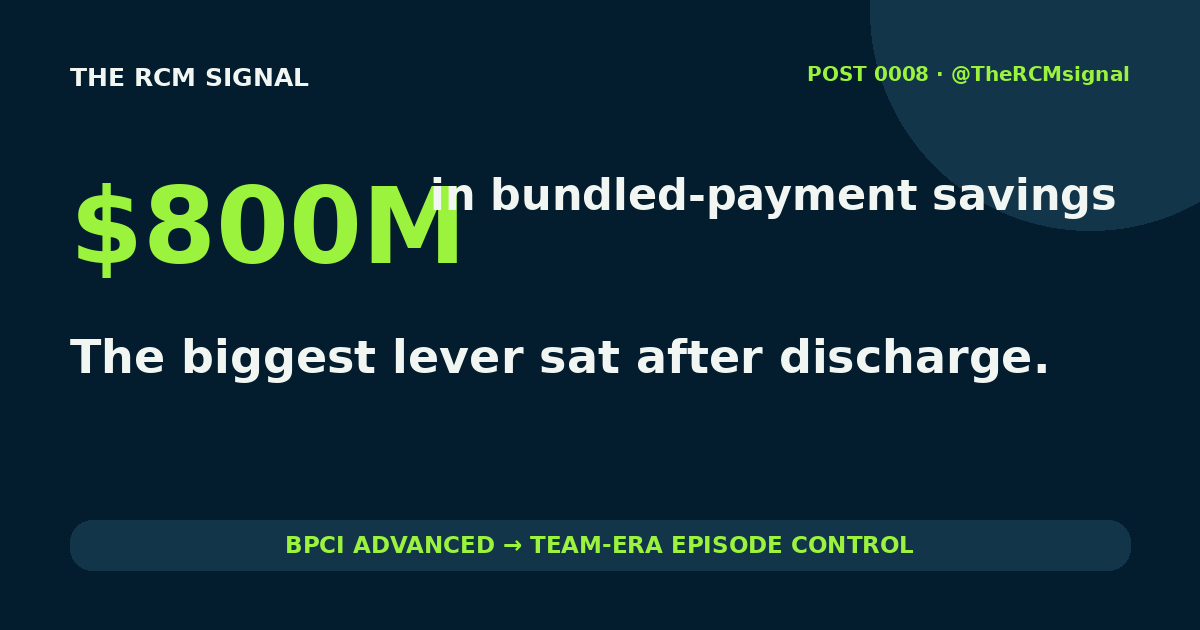
CMS’s final BPCI Advanced evaluation found roughly $800 million in net Medicare savings. The durable revenue-cycle lesson is not a single cost cut—it is an episode-level control system that extends beyond discharge.
The Centers for Medicare & Medicaid Services has released the final evaluation of the Bundled Payments for Care Improvement Advanced model. Across eight model years, the independent evaluation estimated about $800 million in net Medicare savings.
The headline deserves attention. The mechanism deserves more. Savings were not automatic, they were not evenly distributed, and they did not come only from the hospital claim. The largest changes occurred after discharge, when participants reduced avoidable institutional post-acute use, shortened facility stays, and redesigned care transitions.
What the final evaluation found
BPCI Advanced ran from October 2018 through December 2025. More than 1,100 hospitals and 800 physician group practices participated across the model’s eight years, reaching approximately 1.8 million patients and 2.5 million hospital stays or procedures.
The evaluation estimated roughly $800 million in net Medicare savings over the full model period. Participants also reduced episode expenditures in every model year relative to the comparison group, with CMS summarizing reductions of approximately $700 to $1,100 per episode over the course of the model.
That does not mean the model saved Medicare money from day one.
- Model years 1–3: Medicare experienced net losses because reconciliation payments to participants exceeded the reduction in episode expenditures.
- Model year 4 onward: net savings emerged after CMS changed pricing and episode-design methods, including retrospective trend adjustments and more consistent episode-overlap rules.
- Surgical episodes: expenditure reductions were consistently stronger than for medical episodes.
- Later years: participation declined, and the report cautions that estimates for model years 7–8 may be overstated because of data and comparison-method limitations.
CMS also states that BPCI Advanced did not meet the Innovation Center’s criteria for expansion as designed. That distinction matters: a model can produce useful savings and operating lessons without satisfying every statutory test for nationwide expansion.
The largest spending changes happened after discharge
The evaluation says participants primarily reduced Medicare fee-for-service expenditures by decreasing the use and length of stay in institutional post-acute facilities during the 90-day period after discharge.
- For surgical episodes in model years 4–6, the share of patients discharged to a post-acute facility fell by 5 percentage points relative to the comparison group.
- Among patients who had a skilled-nursing stay, the model was associated with approximately 3 fewer SNF days.
- Across model years, skilled-nursing expenditures were approximately $500 lower per episode on average relative to the comparison group.
Participants described a “why not home?” approach when home recovery was clinically appropriate. They also used CMS data to identify higher-quality post-acute providers, build preferred networks, standardize care protocols, and review readmissions with partners.
The operational lesson is not to push every patient home. It is to make the post-acute decision visible, measurable, clinically supported, and connected to the financial episode.
Quality held—but patient preference is a real guardrail
The evaluation found no increase in mortality and no consistent increase in hospital readmissions despite substantial reductions in institutional post-acute use. Those findings counter the concern that lower spending necessarily came from withholding needed care.
The patient-reported results are more nuanced. Most respondents reported positive care experiences, but BPCI Advanced patients were consistently less likely than comparison patients to report that staff took their discharge preferences into account. Some patients also reported not having the caregiver support or other resources required for successful recovery at home.
For revenue-cycle and finance leaders, that is not a side issue. A home-recovery strategy that ignores caregiver capacity, transportation, medications, equipment, or follow-up can create clinical risk, readmissions, avoidable cost, and poor patient experience.
Why this matters now: TEAM is already active
The Transforming Episode Accountability Model began January 1, 2026. CMS lists 716 participating hospitals. The mandatory model covers five surgical episode categories:
- lower extremity joint replacement;
- surgical hip and femur fracture treatment;
- spinal fusion;
- coronary artery bypass graft; and
- major bowel procedures.
TEAM episodes run from the inpatient stay or outpatient procedure through 30 days after discharge. Hospitals and other providers continue to bill Medicare fee-for-service, but CMS compares total included episode spending with a target price and adjusts the result for quality. A hospital may earn a reconciliation payment or owe CMS a repayment.
That structure turns fragmented claims, clinical handoffs, discharge decisions, and post-acute utilization into one financial result.
Build one episode-control record
A practical TEAM-era control record should connect at least seven elements:
- Anchor event. Capture the MS-DRG or HCPCS, setting, procedure date, discharge date, and responsible service line.
- Episode window. Calculate the 30-day period consistently and preserve exclusions, overlap rules, and attribution logic.
- Target economics. Load the preliminary target price, expected discount, risk adjustment, quality adjustment, and internal forecast.
- Included spending. Reconcile inpatient, professional, outpatient, post-acute, home health, therapy, laboratory, DME, Part B drug, and other included claims.
- Post-acute path. Record destination, provider, authorization or referral state, length of stay, home-support plan, and variance from the expected pathway.
- Patient readiness. Make patient preference, caregiver capacity, transportation, medications, equipment, primary-care referral, and follow-up appointments visible before discharge.
- Outcome and reconciliation. Track readmissions, emergency use, quality measures, episode variance, CMS data, and the annual reconciliation result.
The control owner cannot be revenue cycle alone. Finance, case management, clinical operations, quality, physicians, data teams, and post-acute partners must be able to explain the same episode from the same underlying record.
Primary sources
- CMS Innovation Insight: BPCI Advanced Final Evaluation Shows $800M in Net Savings — published September 23, 2026.
- CMS BPCI Advanced Evaluation — Final Evaluation Report — August 2026.
- CMS: BPCI Advanced model page — model period October 1, 2018 through December 31, 2025.
- CMS: Transforming Episode Accountability Model — reviewed September 24, 2026.
- CMS: TEAM Frequently Asked Questions — updated September 22, 2026.
This article is an operational summary for revenue-cycle professionals. It is not legal, clinical, coding, reimbursement, or financial advice. Verify current CMS rules, participant data, target prices, and organization-specific impacts before acting.